 EN
EN
 AR
AR
 BG
BG
 HR
HR
 CS
CS
 NL
NL
 FI
FI
 FR
FR
 DE
DE
 EL
EL
 IT
IT
 KO
KO
 NO
NO
 PL
PL
 PT
PT
 RO
RO
 RU
RU
 ES
ES
 SV
SV
 ID
ID
 LT
LT
 SR
SR
 UK
UK
 VI
VI
 HU
HU
 TH
TH
 TR
TR
 FA
FA
 MS
MS
 HY
HY
 AZ
AZ
 KA
KA
 BN
BN
 LO
LO
 LA
LA
 NE
NE
 MY
MY
 KK
KK
 KY
KY

HVLS Fan Physics: How Low-Speed, High-Volume Airflow Drives Warehouse Circulation
The Aerodynamic Principle: Large-Diameter Blades and Laminar Air Movement
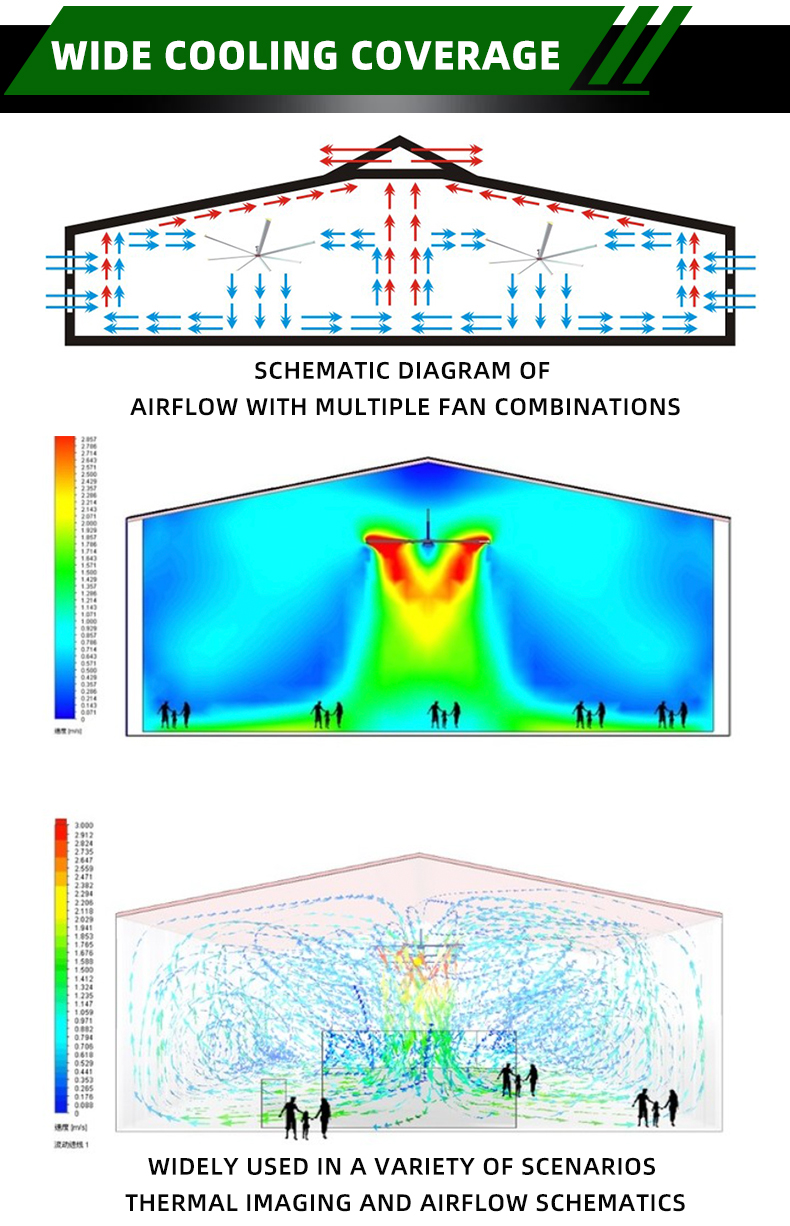
High-Volume, Low-Speed (HVLS) fans use blades spanning 7–24 feet to displace massive air volumes at just 71–200 RPM. Their oversized diameter enables efficient laminar airflow—a smooth, columnar current that travels horizontally along warehouse floors without disruptive turbulence. This design captures 15–30% more air per rotation than conventional fans by adapting aviation-inspired airfoil principles. Minimal rotational friction supports energy efficiency under 1.5 kW and quiet operation below 60 decibels. The resulting coherent airflow eliminates stagnant zones across 15,000+ sq ft per unit—effectively preventing temperature stratification in high-ceiling environments.
Seasonal Dual-Mode Operation: De-stratification in Winter, Evaporative Cooling in Summer
In winter, clockwise rotation pushes trapped ceiling heat downward, reducing vertical temperature differentials by up to 8°F—a performance benchmark verified by ASHRAE (2022). This destratification cuts heating costs by 20–30% in facilities with 25+ ft clearances. In summer, counterclockwise operation delivers consistent 2–4 mph airflow, enhancing evaporative cooling and delivering a 6–8°F perceived temperature drop without thermostat adjustments. Dual-mode use reduces overall facility energy expenditure by 25%, according to Energy Logic (2023), while also lowering condensation risk in sensitive storage areas.
Thermal Destratification: Measurable Heat Redistribution in High-Bay Warehouses
Delta-T Reductions: Up to 8°F Ceiling-to-Floor Temperature Equalization
Thermal stratification in high-bay warehouses can create ceiling-to-floor temperature differentials exceeding 15°F. HVLS fans counteract this by generating columnar airflow that gently pushes warm air downward and draws cooler air upward, enabling continuous mixing. Documented Delta-T reductions of up to 8°F (ASHRAE Journal, 2023) confirm the effectiveness of this laminar circulation—delivering consistent thermal comfort for workers and measurable heating energy savings during colder months.
Limitations and Mitigation: Ceiling Height, Obstructions, and Airflow Path Integrity
Effectiveness depends on environmental factors. Ceilings under 18 ft risk turbulent overspill due to insufficient blade clearance; those over 40 ft may require supplemental units to sustain airflow velocity. Obstructions covering more than 30% of floor area—such as dense racking or equipment—can reduce temperature equalization by up to 50%. Mitigation includes:
- Mounting adjustments: Tilting fans 3–5° to route airflow around major obstructions
- Zonal supplementation: Adding axial fans in congested operational zones
-
Path optimization: Aligning fan placement with natural convection currents
Thermal anemometer-based airflow mapping validates coverage integrity and ensures reliable destratification cycles.
HVLS Fans and Energy Efficiency: Cutting HVAC Load Through Uniform Air Circulation
HVLS fans significantly reduce HVAC energy demand by eliminating thermal stratification—the natural layering of warm air near ceilings and cooler air near floors. By continuously mixing air layers, they achieve temperature equalization that lowers heating demand by up to 30% in winter and creates a 6–8°F perceived cooling effect in summer—without altering thermostat settings. Department of Energy studies confirm 20–50% HVAC energy savings in properly implemented systems. Operationally, a single 24-foot HVLS fan consumes just 1.1 kW/hr—replacing 10–20 high-speed fans and cutting electrical load by over 80%. This dual reduction in HVAC runtime and fan power consumption typically delivers ROI within 1–3 years.
Warehouse-Specific HVLS Fan Optimization: Sizing, Placement, and System Integration
Diameter-to-Clearance Guidelines: Matching HVLS Fan Size to 20–60 ft Ceiling Heights
Fan diameter must align with ceiling height to ensure effective downwash and laminar flow. For 20–30 ft ceilings, 8–12 ft diameter units provide optimal floor-level air delivery. Facilities with 30–50 ft clearances require 14–20 ft fans to overcome thermal resistance, while 50–60 ft spaces benefit from 24+ ft models to penetrate dense heat layers. Maintain a minimum 3–5 ft clearance from structural elements—including lighting, ductwork, and sprinkler systems—to preserve blade safety and airflow integrity.
Strategic Spacing and Mounting for Turbulence-Free, Overlapping Coverage Patterns
For multi-fan installations, space units 1.5–2 fan diameters apart to create seamless, overlapping coverage—eliminating dead zones and maximizing circulation uniformity. Angling mounts 3–7° enhances horizontal air throw while minimizing turbulence near racking or machinery. Keep 7–10 ft vertical clearance above work zones to ensure both personnel safety and unimpeded airflow. This configuration sustains consistent temperature equalization and has been shown to reduce annual HVAC runtime by 30%.
Frequently Asked Questions
What are HVLS fans?
HVLS fans are High-Volume, Low-Speed fans that use large, slow-moving blades to move significant amounts of air in large spaces such as warehouses.
How do HVLS fans help with energy efficiency?
HVLS fans help with energy efficiency by reducing HVAC demand through temperature equalization, which lowers heating and cooling needs.
What should be considered in HVLS fan placement?
When placing HVLS fans, consider ceiling height, potential obstructions, and room size to ensure optimal air circulation and efficiency.
Can HVLS fans be used in both summer and winter?
Yes, HVLS fans operate in dual-mode: pushing warm air down in winter and providing evaporative cooling in summer.
Table of Contents
- HVLS Fan Physics: How Low-Speed, High-Volume Airflow Drives Warehouse Circulation
- Thermal Destratification: Measurable Heat Redistribution in High-Bay Warehouses
- HVLS Fans and Energy Efficiency: Cutting HVAC Load Through Uniform Air Circulation
- Warehouse-Specific HVLS Fan Optimization: Sizing, Placement, and System Integration
- Frequently Asked Questions
 ONLINE